
30 September 2026
Little Inventors: Rescue the Chickens
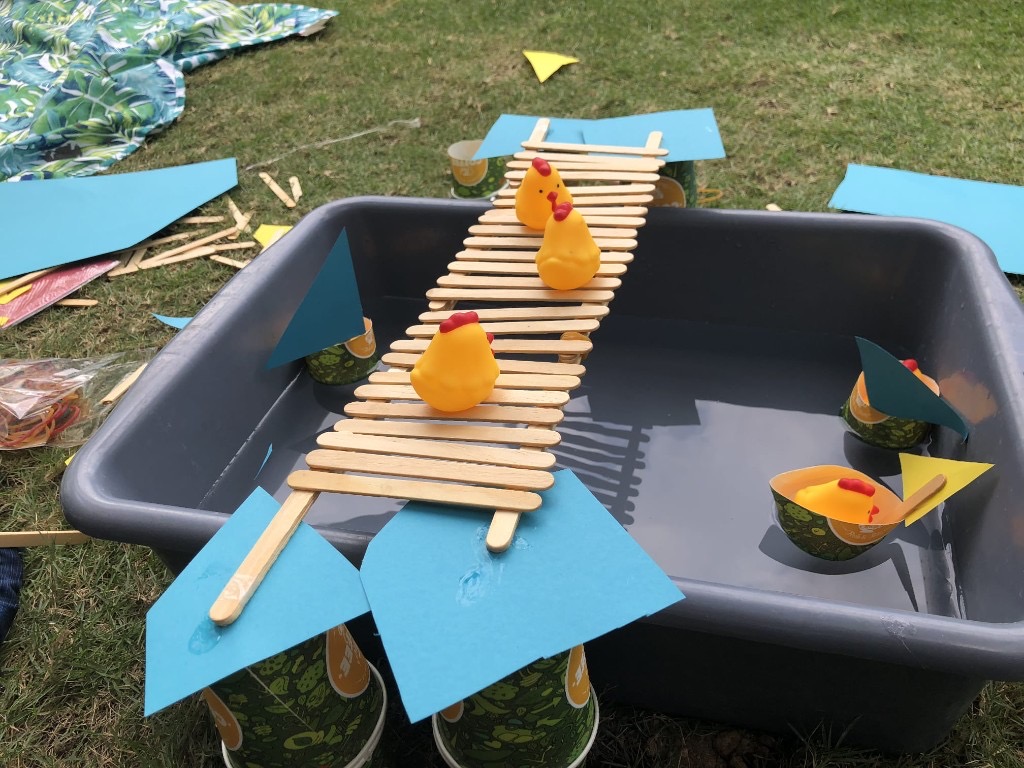
This morning the Little Inventors had one job: get the chickens out of the water. Nobody handed them a finished plan. They looked at the tub, looked at the materials, and came up with two ways to do it.
We set out a box of water, a few rubber chickens, and a pile of ordinary materials: craft sticks, paper cups, coloured paper, and rubber bands. The chickens were stranded. The children had to work out how to rescue them.
We did not start with a model to copy. We started with a problem. The children looked at the water, tried a few ideas with their hands, and talked about what might actually hold a chicken. Two plans took shape.
Build a bridge
The first idea was to stay out of the water entirely. The children laid craft sticks across the tub to make a walkway, set paper cups underneath as supports, and used sheets of blue paper as landings at each end. Then they tested it. One chicken. Then another. Then a third, lined up along the deck.
A bridge only counts if it holds. Sticks slip. Cups tip. The deck has to be wide enough for a chicken to stand on. The children kept adjusting until the chickens could cross from one side of the water to the other.
Build a boat
The second idea was to travel on the water. They turned paper cups into hulls, pushed a craft stick through as a mast, and cut paper triangles for sails. A chicken went in. The cup floated. Another boat followed, with a different sail.
A boat asks different questions from a bridge. Will the cup stay upright? Is the chicken too heavy? Does the sail help it move, or just decorate it? The children found out by putting a chicken in and watching what the water did.
What they were really practising
Both ideas worked. That was the point. There was more than one way to rescue a chicken, and the children had to choose, build, and check.
Along the way they practised the things Little Inventors is for:
- Looking before building. The water was the constraint. Anything that fell apart or sank did not count as a rescue.
- Using simple materials on purpose. A cup can be a support or a hull. A stick can be a deck or a mast. The material does not decide. The idea does.
- Testing in public. If the bridge wobbled or the boat tipped, everyone could see it. Then they changed something and tried again.
- Sharing the problem. One group spanned the tub. Another group floated across it. Different plans, same goal.
At Wonder Kids, this is what STEM looks like for young children. Not a worksheet. A tub of water, a handful of sticks, and enough time to discover that a good idea is one you can build and prove.